
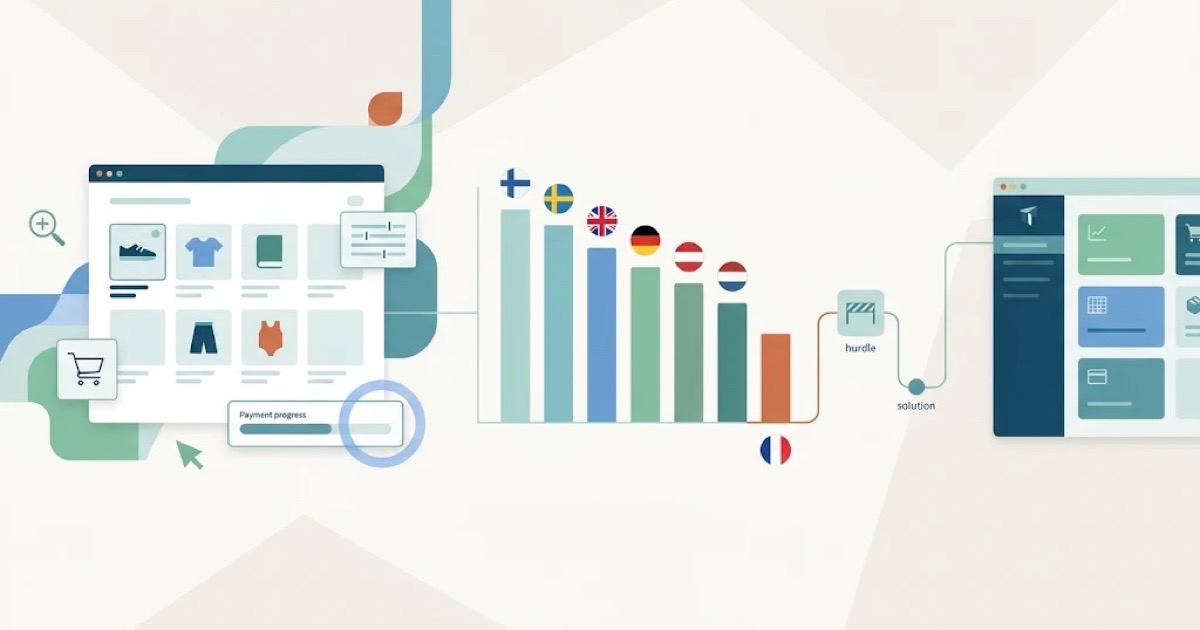
The Contentsquare Foundation’s 2026 Digital Accessibility Barometer, based on audits carried out between June and August 2026, compares seven European markets. For e-commerce, the verdict is clear: France comes last. Here are the key figures and what they mean for a small online store.
The 2026 barometer in figures
- E-commerce: France scores 7.01 out of 10, against an average of 7.41 across the seven markets. It ranks 7th out of 7.
- Top of the table: Sweden (7.89), the United Kingdom (7.79) and Germany (7.57). Spain, Italy and the Netherlands are also ahead of France.
- Across all sectors, France ranks 6th out of 7, with an average of 7.44. It is also last for media, but above average for public services (8.67).
Be careful about what this ranking measures: it does not rate what stores sell, but how easy they are for everyone to use, including people who browse with a keyboard, a screen reader or enlarged text.
Three common defects on European websites, across all sectors
- 83% of the pages tested cope badly with more spacious text: as soon as line or letter spacing is increased, elements overlap or get cut off, like a price slipping under a photo.
- 67% make the keyboard indicator invisible: moving with the Tab key, you no longer know which link or button is selected.
- 45% contain elements poorly described in the code: a screen reader announces “button” without saying whether it adds to the cart or removes an item.
Why it matters for sales
For a merchant, the slightest blockage has a direct cost: a customer who cannot pick a size or confirm their address does not call back, they go elsewhere. The barometer gives no figure, but anyone who tracks abandoned carts knows the pattern: every bit of friction pushes the number up.
What the regulations say
The rules changed on 28 June 2025: online stores covered by the European accessibility rules must now comply, including those launched before that date. The smallest businesses may be exempt in some cases: check with your national authority whether your business is concerned.
Check your store in 15 minutes
- With the keyboard: go through a complete order with the Tab key, from the product page to payment. You should always see where you are.
- Enlarge the text (browser zoom at 200%): no price, option or button should disappear.
- Review your forms: each field needs a clear label (“Postcode”, not just a greyed-out example).
- Name your buttons: “Add to cart” or “Request a quote” rather than a bare icon.
- Test on mobile, where most purchases happen.
What we take away for small stores
For a craftsperson or a small business, this ranking is rather good news: the bar is not high, since large retailers have not pulled ahead. A modest but well-kept store can therefore offer a better experience than a big website, provided it tests its own store from time to time, the way a customer in a hurry would.
Fewer steps, fewer obstacles
A short, clear purchase path is easier to make accessible. For products that are hard to sell online (made to measure, variable quantities, many options), a simple form is often better than a complex configurator: the customer describes their needs in a few fields and you reply. That is the whole point of adding a quote request to WordPress.
Torlann, the free WordPress plugin for selling online and receiving quote requests, was designed in this spirit: few steps, explicit buttons and short forms. It does not replace an accessibility audit, but it avoids piling up screens.
Source: Contentsquare Foundation 2026 Digital Accessibility Barometer (audits carried out between June and August 2026), reported by Économie Matin on 16 November 2026.